Theme 4: Grand Challenge Applications - Research Highlights
GenDRAM: Hardware-Software Co-Design of General Platform in DRAM
Authors:
Tsung-Han Lu, Weihong Xu, and Tajana Rosing
Affiliations: University of California, San Diego (UCSD)
Repository / Publication: arXiv:2602.23828 (cs.AR)
Date: February 2026
DOI: 10.48550/arXiv.2602.23828
Abstract:
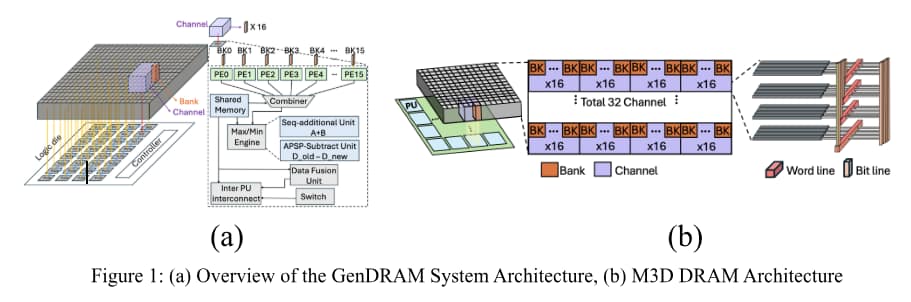
Dynamic programming (DP) algorithms, such as All-Pairs Shortest Path (APSP) and genomic sequence alignment, are fundamental to many scientific domains but are severely bottlenecked by data movement on conventional architectures. While Processing-in-Memory (PIM) offers a promising solution, existing accelerators often address only a fraction of the work-flow, creating new system-level bottlenecks in host-accelerator communication and off-chip data streaming. In this work, we propose GenDRAM, a massively parallel PIM accelerator, (Figure 1(a)), that overcomes these limitations. GenDRAM leverages the immense capacity and internal bandwidth of monolithic 3D DRAM(M3D DRAM), illustrated in Figure 1 (b), to integrate entire data-intensive pipelines, such as the full genomics workflow from seeding to alignment, onto a single heterogeneous chip. At its core is a novel architecture featuring specialized Search PUs for memory-intensive tasks and universal, multiplier-less Compute PUs for diverse DP calculations. This is enabled by a 3D-aware data mapping strategy that exploits the tiered latency of M3D DRAM for performance optimization. Through comprehensive simulation, we demonstrate that GenDRAM achieves a transformative performance leap, outperforming state-of-the-art GPU systems by over 68× on APSP and over 22× on the end-to-end genomics pipeline.
Windsock is Dancing: Adaptive Multimodal Retrieval-Augmented Generation
Authors:
Shu Zhao, Tianyi Shen, Nilesh Ahuja, Omesh Tickoo, and Vijaykrishnan Narayanan.
Affiliations: The Pennsylvania State University & Intel
Repository / Publication: arXiv (arXiv:2510.22694) / PMLR (Vol. 322)
Publication Date: October 2025
Abstract:
Multimodal Retrieval-Augmented Generation (MRAG) has emerged as a promising method to generate factual and up-to-date responses of Multimodal Large Language Models (MLLMs) by incorporating non-parametric knowledge from external knowledge bases. However, existing MRAG approaches suffer from static retrieval strategies, inflexible modality selection, and suboptimal utilization of retrieved information, leading to three critical challenges: determining when to retrieve, what modality to incorporate, and how to utilize retrieved information effectively. To address these challenges, we introduce Windsock, illustrated in Figure 2, a query dependent module making decisions on retrieval necessity and modality selection, effectively reducing computational overhead and improving response quality. Additionally, we propose Dynamic Noise Resistance (DANCE) Instruction Tuning, an adaptive training strategy that enhances MLLMs’ ability to utilize retrieved information while maintaining robustness against noise. Moreover, we adopt a self-assessment approach leveraging knowledge within MLLMs to convert question-answering datasets to MRAG training datasets. Extensive experiments demonstrate that our proposed method significantly improves the generation quality by 17.07% while reducing 8.95% retrieval times.

Monolithic 3D FPGA Design and Synthesis with Back-End-of-Line Configuration Memories
Authors:
Faaiq Waqar, Jiahao Zhang, Anni Lu, Zifan He, Jason Cong, Shimeng Yu
Affiliations: Georgia Institute of Technology & University of California – Los Angeles
DOI: 10.1109/DAC63849.2025.11132615
Publication Date: September 2025
Abstract:
This work presents a novel monolithic 3D (M3D) FPGA architecture that leverages stackable back-end-of-line (BEOL) transistors to implement configuration memory and pass gates, significantly improving area, latency, and power efficiency. By integrating n-type (W-doped In2O3) and p-type (SnO) amorphous oxide semiconductor (AOS) transistors in the BEOL, Si SRAM configuration bits are substituted with a less leaky equivalent that can be programmed at logic-compatible voltages. BEOL-compatible AOS transistors are currently under extensive research and development in the device community, with investment by leading foundries, from which reported data is used to develop robust physics-based models in TCAD that enable circuit design. The use of AOS pass gates reduces the overhead of reconfigurable circuits by mapping FPGA switch block (SB) and connection block (CB) matrices above configurable logic blocks (CLBs), thereby increasing the proximity of logic elements and reducing latency. By interfacing with the latest Verilog-to-Routing (VTR) suite, an AOS-based M3D FPGA implemented in 7 nm technology is demonstrated with 3.4x lower area-time squared product (AT2), 27% lower critical path latency, and 26% lower reconfigurable routing block power on benchmarks including hyperdimensional computing and large language models (LLMs).

Single-Cell Universal Logic-in-Memory Using 2T-nC FeRAM: An Area and Energy-Efficient Approach for Bulk Bitwise Computation
Authors:
Rudra Biswas, Jiahui Duan, Shan Deng, Xuezhong Niu, Yixin Qin, Prapti Panigrahi, Varun Parekh, Rajiv Joshi, Kai Ni, and Vijaykrishnan Narayanan
Affiliations: The Pennsylvania State University, University of Notre Dame, IBM T. J. Watson Research Center
DOI : 10.1109/SOCC66126.2025.11235435
Publication Date: November 2025
Abstract:
This work presents a novel approach to configure 2T-nC ferroelectric RAM (FeRAM) for performing single cell logic-in-memory operations, highlighting its advantages in energy-efficient computation over conventional DRAM-based approaches. Unlike conventional 1T-1C dynamic RAM (DRAM), which incurs refresh overhead, 2T-nC FeRAM offers a promising alternative as a non-volatile memory solution with low energy consumption. Our key findings include the potential of quasi-nondestructive readout (QNRO) sensing in 2T-nC FeRAM for logic-in-memory (LiM) applications, demonstrating its inherent capability to perform inverting logic without requiring external modifications, a feature absent in traditional 1T-1C DRAM. We successfully implement the MINORITY function, shown in Figure 4(a), within a single cell of 2T-nC FeRAM, enabling universal NAND and NOR logic, validated through SPICE simulations and experimental data. Additionally, the research investigates the feasibility of 3D integration with 2T-nC FeRAM, highlighted in Figure 4(b), showing substantial improvements in storage and computational density, facilitating bulk-bitwise computation. Our evaluation of eight real-world, data-intensive applications reveals that 2T-nC FeRAM achieves 2x higher performance and 2.5x lower energy consumption compared to DRAM. Furthermore, the thermal stability of stacked 2T-nC FeRAM is validated, confirming its reliable operation when integrated on a compute die. These findings emphasize the advantages of 2T-nC FeRAM for LiM, offering superior performance and energy efficiency over conventional DRAM.
