Learning Semantics, Not Addresses: Runtime Neural Prefetching for Far Memory
Authors:
* Yutong Huang, Zhiyuan Guo, Yiying Zhang. Learning Semantics, Not Addresses: Runtime Neural Prefetching for Far Memory. [Online]. Available:https://arxiv.org/html/2506.00384v2
Abstract:
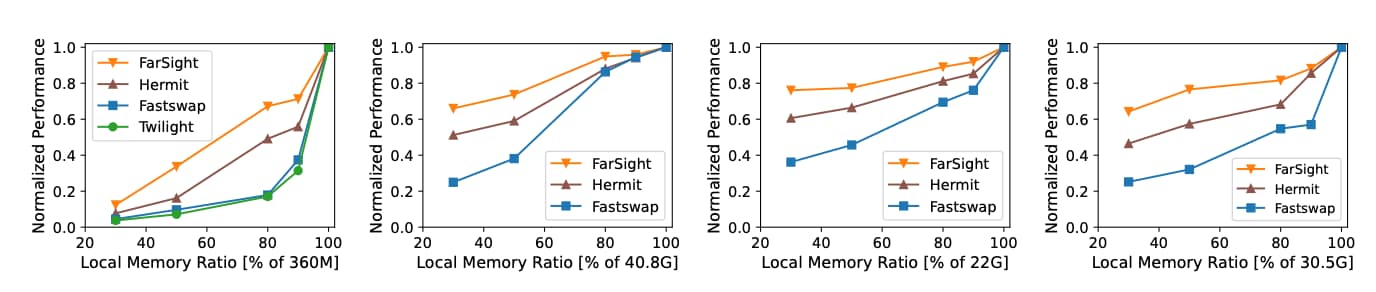
Memory prefetching has long boosted CPU caches and is increasingly vital for far-memory systems, where large portions of memory are offloaded to cheaper, remote tiers. While effective prefetching requires accurate prediction of future accesses, prior ML approaches have been limited to simulation or small-scale hardware. This work introduces FarSight (Figure 1), the first Linux-based far-memory system to leverage deep learning by decoupling application semantics from runtime memory layout. This separation enables offline-trained models to predict access patterns over a compact ordinal vocabulary, which are resolved at runtime through lightweight mappings. Across four data-intensive workloads, FarSight delivers up to 3.6× higher performance than the state-of-the-art.
Figure 1. FarSight.
Rethinking Inter-Process Communication with Memory Operation Offloading
Authors:
* Misun Park, Richi Dubey, Yifan Yuan, Nam Sung Kim, Ada Gavrilovska. Rethinking Inter-Process Communication with Memory Operation Offloading. [Online]. Available:https://arxiv.org/abs/2601.06331
Abstract:
Data movement accelerators such as Intel Data Streaming Accelerator (DSA) are increasingly proposed to address the rising cost of intra-node data movement in high-throughput IPC (Inter-Process Communication). Modern data-centric workloads transfer tens to hundreds of megabytes per request, making memory copies a primary bottleneck in latency and CPU utilization. Offloading appears attractive because it can reclaim CPU cycles and reduce cache pressure. However, without careful integration, it can degrade performance instead of improving it. This work presents a system-level characterization of Intel DSA in user-space IPC and identifies key trade-offs, summarized in Table 1: (1) data sizes, (2) synchronization overhead from polling-based completion, (3) sensitivity to memory state, especially page faults under shared virtual memory, and (4) cache locality and interference from cache injection. Although DSA can reduce latency by tens of microseconds for large transfers, inefficient polling, runtime page faults, or cache contention can eliminate these gains. The study show that memory offload engines are not drop-in replacements for CPU memcpy operations. Their benefits depend on coordinated integration with synchronization, virtual memory, and cache subsystems. The work establishes hardware-aware design guidelines for adaptive offloading, hybrid polling, pinned or pre-faulted memory management, and contention-aware cache control.
Table 1. Trade-Offs and Design Guidelines for DSA-Based IPC.